Enterprise Drone Service Requirements Checklist
Table of Contents
- The Enterprise Drone Service Requirements Checklist That Gets You Scored
- Build a Drone Operations Quality Assurance Manual Buyers Can Audit
- The Procurement Disqualification Criteria for Drone Operators You Never See
- Frequently Asked Questions
Last Updated: October 2, 2026
The Enterprise Drone Service Requirements Checklist That Gets You Scored
Your response was eliminated before anyone opened your pricing. The enterprise drone service requirements checklist that governs your bid is not the one in the solicitation. It is the screen the evaluator runs before scoring starts.
The pattern holds: accuracy claims with no method, QA described as a value rather than a procedure, and no answer on data custody. Each is a cut line.
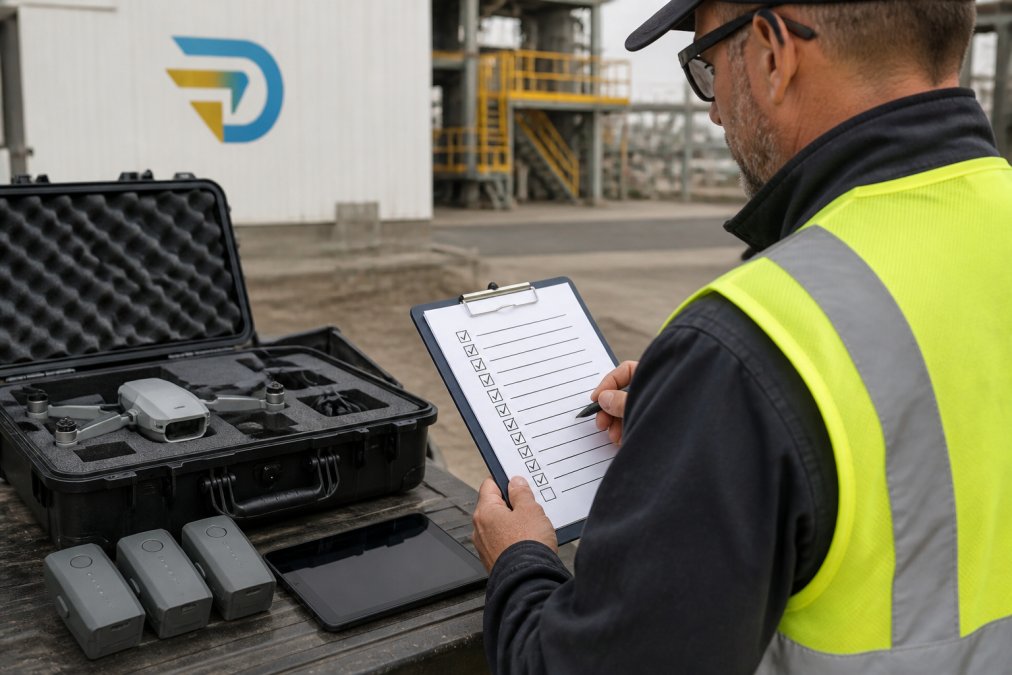
Here is what actually gets scored:
- Accuracy tied to a reproducible method, not a number
- QA written as a documented procedure
- Deliverables specified to end use
- Data custody and retention answered before legal asks
- Safety and regulatory evidence that is more than a certificate number
- A complete procurement package, submitted early
- Capacity and continuity stated plainly
- Pricing built for the contract vehicle
Build a Drone Operations Quality Assurance Manual Buyers Can Audit
A drone operations quality assurance manual is a written procedure set an outside reviewer can audit, not a statement that you care about quality. Buyers score the procedure, not your intent.
Document these as steps, with a responsible role and a record for each:
- Pre-flight inspection, recorded per aircraft per flight
- Battery health monitoring, with charge and cycle history
- Propeller integrity and motor system checks, logged
- Firmware updates and sensor calibration, versioned
- Post-flight cleaning and debris removal, signed off
- Telemetry data and maintenance logs, retained
- Chain-of-custody for every data handoff
- Emergency protocols and risk mitigation, rehearsed
If a step has no record, it did not happen as far as the evaluator is concerned.
The Procurement Disqualification Criteria for Drone Operators You Never See
Procurement disqualification criteria for drone operators rarely appear in the solicitation. They live in the evaluator's checklist and eliminate responses before scoring.
The screens that cut responses:
| Screen | What gets you cut |
|---|---|
| Accuracy | A number nobody could reproduce |
| QA | QA described as a value, not a procedure |
| Deliverables | A sensor spec sold as a deliverable |
| Data custody | No answer until legal asks |
| Safety evidence | A certificate offered as a program |
| Package | One missing certificate at a deadline |
| Capacity | A one-person operation described as a company |
| Pricing | A project quote against a program requirement |
Two get missed more than the rest. Data custody and retention is one: the answer must name where data lives, who can reach it, and when it is destroyed. The other is pilot competency verification, how you confirm the remote pilot in command on this contract is current, not just that one exists.
Environmental-specific requirements are the third gap. Airspace, seasonal restrictions, and site conditions change what you can fly and when. Say how you handle them in the response, not after award.
Capacity and continuity decide the rest. If you are a one-person shop, do not describe yourself as a company. State the crew you can field, the spare parts you hold, and how you cover a schedule when a pilot is out. Supply chain and spare parts management is a scored line for multi-site work.
One change, this afternoon: rewrite your accuracy statement so the method sits next to the number, and add a retention date to your data custody answer. That is the difference between a response that gets scored and one that gets screened out. If you want a second set of eyes on a live bid, the Drone Deal Teardown walks through a single response and shows you where it would get cut.
Frequently Asked Questions
What documentation is required for enterprise drone contracts?
Expect to produce a certificate of insurance, a written safety program, maintenance and flight logs, and a quality assurance procedure that names the standard you hold yourself to, such as ASPRS positional accuracy classes with RMSE reported separately for horizontal and vertical. Procurement reviewers check whether each document exists before they read pricing. Build the package once and keep it current, because deadlines for missing certificates rarely get extended.
How do you prove data custody in drone service agreements?
Show the chain-of-custody in writing: who collects the data, where it is stored, how it is transferred, who can access it, and when it is deleted. State a retention period and name the person accountable for it. If your UAV data security and retention standards are only described as a value rather than a procedure, the response stalls until legal asks for an answer you should have written already.
What is the difference between a drone service quote and a program requirement?
A quote prices a project. A program requirement prices a contract vehicle, meaning a defined term, deliverable schedule, reporting cadence, and renewal structure the buyer already committed to. Submitting a project quote against a program requirement is one of the most common procurement disqualification criteria for drone operators, because the response never addresses the terms the buyer is actually scoring.
Enterprise work is lost on the response, not the price. The operators who win it treat the checklist as a document they can defend line by line. The Drone Strategist helps operators build responses that survive procurement review, from the quality assurance manual to the data custody answer to the pricing structure that fits the contract vehicle. Start with the Disqualification Checklist and find the screen your last response failed.
