Transitioning from Gigs to Enterprise Contracts
Table of Contents
- What Changes When You Move from Gigs to Enterprise Contracts
- The Enterprise Drone Procurement Process: What Gets Screened Before Pricing
- Building Industrial Drone Inspection Proposal Templates That Survive Review
- Frequently Asked Questions
Last Updated: October 4, 2026
What Changes When You Move from Gigs to Enterprise Contracts
A one-off roof inspection gets approved by the person who hired you. An enterprise agreement gets approved by people who never meet you, using a scoring sheet you never see.
Moving from gigs to enterprise contracts means a procurement reviewer scores a document, not the client who watched you fly. The response gets cut before anyone opens the pricing. Miss one screen and you are out, no matter what you charge.
The Enterprise Drone Procurement Process: What Gets Screened Before Pricing
The enterprise drone procurement process is the sequence a buyer uses to eliminate vendors before any commercial terms are discussed. It runs on completeness and traceability, not sample imagery.
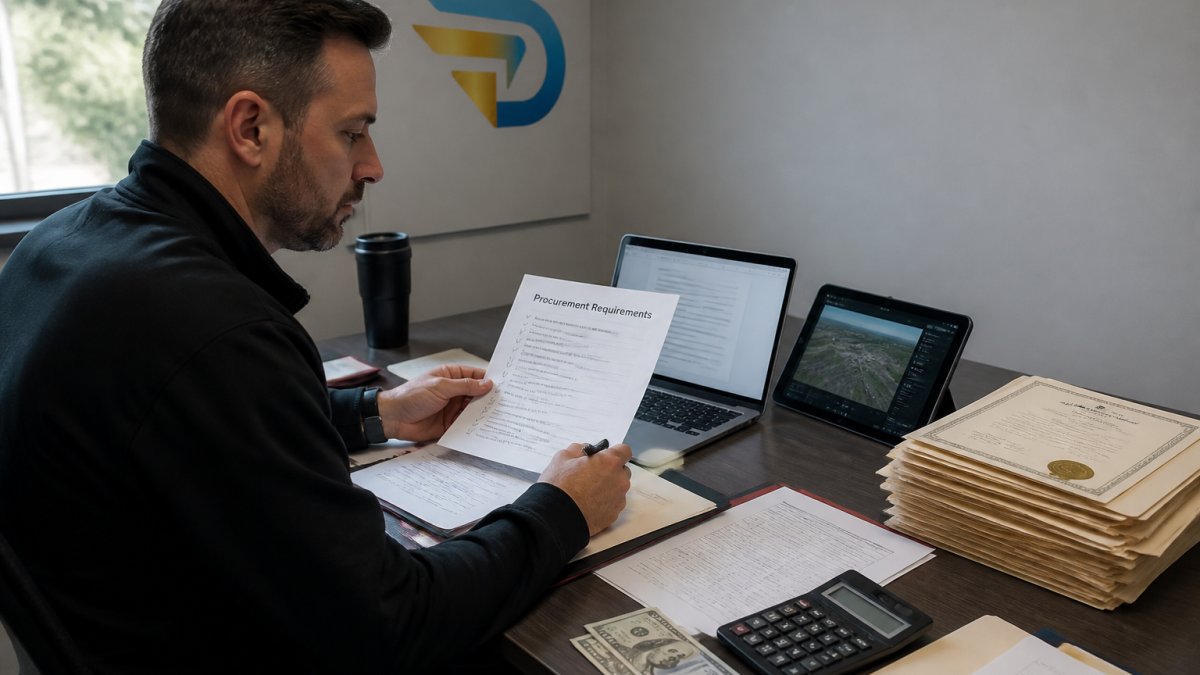
Treating the response as a description of your services is a mistake. The reviewer reads for answers to specific requirements. The screens that cut responses most often:
- Accuracy tied to method. An accuracy number with no stated method cannot be reproduced, so it cannot be accepted.
- QA as a documented process. QA described as a value instead of a procedure.
- Deliverables specified to end use. A deliverable list that is really a sensor spec.
- Data custody and retention. No answer at all, until legal asks for one.
- Safety and regulatory evidence. A certificate number offered as a safety program.
- Procurement package completeness. One missing certificate at a deadline nobody extends.
- Capacity and continuity. A one-person operation described as a company.
- Pricing built for the contract vehicle. A project quote submitted against a program requirement.
Seven of the eight have nothing to do with price. You lose on the response before the number matters.
When you state accuracy, name the standard. ASPRS positional accuracy classes exist for a reason, and NSSDA expects RMSE reported separately for horizontal and vertical. A blended number tells the reviewer you have not read the requirement.
Contract mechanics are not ours to advise on. What to look for in an MSA, an SOW, or a service level agreement is a question for your counsel. Your job is to not leave those questions open.
Building Industrial Drone Inspection Proposal Templates That Survive Review
Industrial drone inspection proposal templates survive review when they are built around the buyer's requirements, not your capabilities. A template is a structure for evidence. If it reads like a brochure, it gets screened. Each block maps to a screen.
| Response Block | Answers Which Screen | What the Reviewer Needs |
|---|---|---|
| Accuracy statement | Accuracy tied to method | Standard named, RMSE split horizontal and vertical |
| QA section | QA as a documented process | Steps, checkpoints, who signs off |
| Deliverables | Deliverables to end use | What the client receives and in what form |
| Data handling | Data custody and retention | Where data lives, for how long, who can access it |
| Safety and compliance | Safety and regulatory evidence | Program description, not just a certificate number |
| Package checklist | Procurement completeness | Every required document, listed and attached |
| Capacity statement | Capacity and continuity | Who does the work when you cannot |
| Pricing schedule | Pricing for the contract vehicle | Rates matched to the vehicle, not a project quote |
Build the template once, then fill it per opportunity. The structure is reusable. The evidence is variable.
On QA, write the procedure. A reviewer wants a second person checking the data, a defined pass or fail, and a record of that check. "Flight data reviewed against [placeholder: your QA checklist name], discrepancies logged and resolved before delivery" is closer than "we ensure high quality."
On deliverables, describe the end use. If the client needs a condition report for an asset manager, shape the deliverable around it. A list of sensors is not a deliverable.
On capacity, be honest. If you are a solo operator, say how you scale and who backs you up. A one-person operation described as a company reads as a continuity risk.
The hard part is not writing the response. It is knowing which screen your last response failed, because nobody tells you. If you have been cut before pricing and never learned why, fix that first. A Drone Deal Teardown can show you exactly where a past response lost points, and the Enterprise Drone Deal Accelerator walks through the full process of building responses that get scored instead of screened.
The Drone Strategist builds operators who get scored instead of screened.
Frequently Asked Questions
What documentation is required to qualify for enterprise drone contracts?
Procurement packages typically require a certificate of insurance naming the client as additional insured, proof of remote pilot certification, a written safety program, and a documented QA procedure. Missing any one of these at the submission deadline gets the response screened out before anyone reads pricing. Build a standard package you can attach to every bid.
How do enterprise procurement teams evaluate drone service providers?
They screen first, score second. Accuracy claims tied to a reproducible method, QA described as a procedure rather than a value, deliverables specified to end use, and data custody answers all pass the screen. A certificate number offered as a safety program does not. The response that survives screening is the one that gets scored.
What is the difference between a project-based gig and an enterprise service agreement?
A gig is a scope and a price. An enterprise agreement is a contract vehicle: a master service agreement with statements of work, service level agreements, liability terms, and billing cycles. The procurement process evaluates whether you can operate inside that structure, not whether you can fly the mission.
